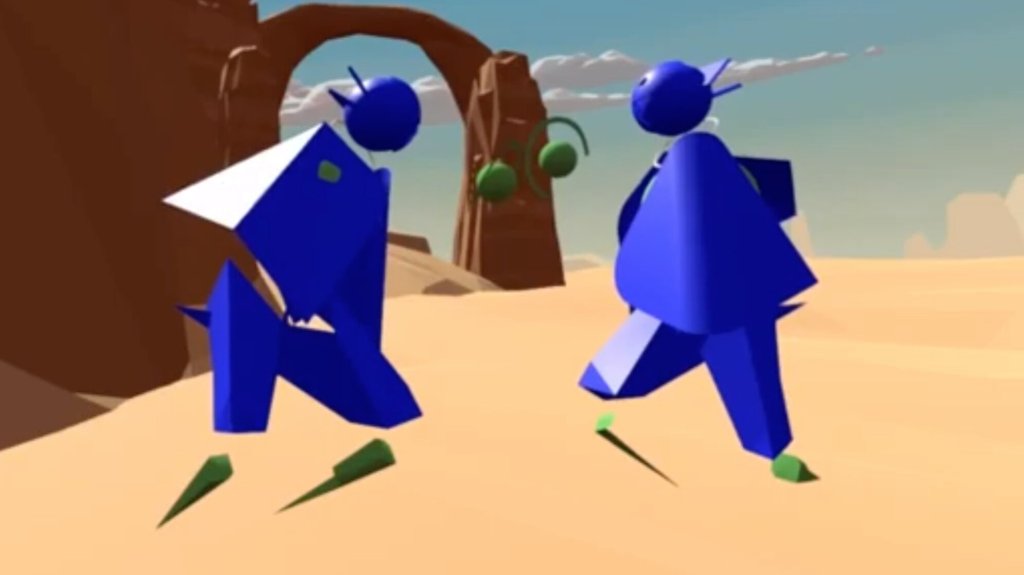
During the pandemic we all became familiar with “zoom fatigue.” Jeremy Bailenson from the Stanford Human Interaction Lab published a study on this phenomenon which magnifies the fact that 2d media is fundamentally different then embodied media (VR). This study reveals a “secret” language of movement that most of us were not aware of until we were forced to communicate without it. This phenomenon has been studied for decades in separate parts relating to the communication bodies make subconsciously depending on who they are around and how close they are to each other. The way our bodies respond to each other in 3d space represent more then half of all communication. Speaking this language of movement and proximity is essential to the craft of the Ractor.
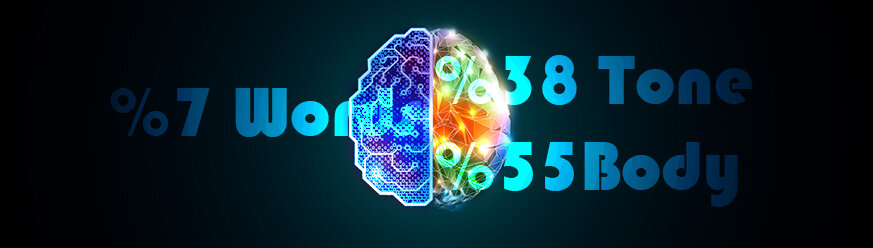
Albert Mehrabian’s findings on inconsistent messages of feelings and attitudes (the “7%-38%-55% Rule”) relate to the relative impact of words, tone of voice, and body language when speaking
FIGHT, FLIGHT or F***
Bailenson’s study found that the eye contact, and the size of faces on screens during Zoom calls feels unnatural. In a normal meeting, people will variously be looking at the speaker, taking notes or looking elsewhere. But on Zoom calls, everyone is looking at everyone all the time, and the amount of eye contact is dramatically increased. Also, faces on videoconferencing calls appear too large for comfort. “In general, for most setups, if it’s a one-on-one conversation when you’re with coworkers or even strangers on video, you’re seeing their face at a size which simulates a personal space that you normally experience when you’re with somebody intimately,” Bailenson said.
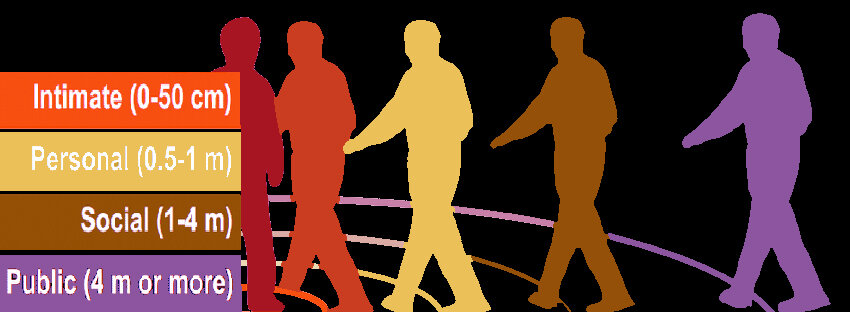
“Proxemics is one category in the study of nonverbal communication. Edward T. Hall defines it as “the interrelated observations and theories of humans use of space as a specialized elaboration of culture”
When someone’s face is that close to ours in real life, our brains interpret it as an intense situation that is either going to lead to mating or to conflict. “What’s happening, in effect, when you’re using Zoom for many, many hours is you’re in this hyper-aroused state,” Bailenson said.
Years of physical theater training has revealed something incredible. We all have an incredibly refined sensitivity for nonverbal communication. The moment an actor steps onstage his body cannot help but convey his internal state. If they are uncomfortable and tense (like most sane people are in front of an audience,) it is immediately apparent to all viewers. This means their physiology is in a “defensive” mode activating deeper brain structures that are responsible for managing neurological programming used for defending the body from attackers. Studies show observers will represent unintentional group synchrony to this posture and adopt similar physical and neurological patterns of stress. An expert Ractor trains their physical presence in space to diffuse this defense response. This can open the audience up to a new range of emotions, bypassing this ancient defense wiring and can unconsciously change an audience member’s posture and neurology to a state where they accept the ractor as they would an intimate friend or family member.
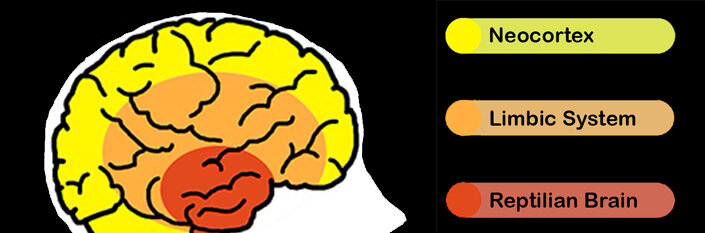
The triune brain is a model of the vertebrate forebrain proposed by neuroscientist Paul D. MacLean. It consists of the reptilian complex, the paleomammalian complex (limbic system), and the neomammalian complex (neocortex), each independently conscious and sequentially added to the forebrain in the course of evolution
NONVERBAL OVERLOAD
Bailenson notes that in regular face-to-face interaction, nonverbal communication is quite natural and each of us makes and interprets gestures and nonverbal cues subconsciously. But in video chats, we have to work harder to send and receive signals. Often these signals which are easily communicated in person are easy to misinterpret without the physical context sharing space provides naturally.
 aritarr.com